
Why the lower back can go into protection — and how Body Stress Release looks at stored tension
It can happen in a second.
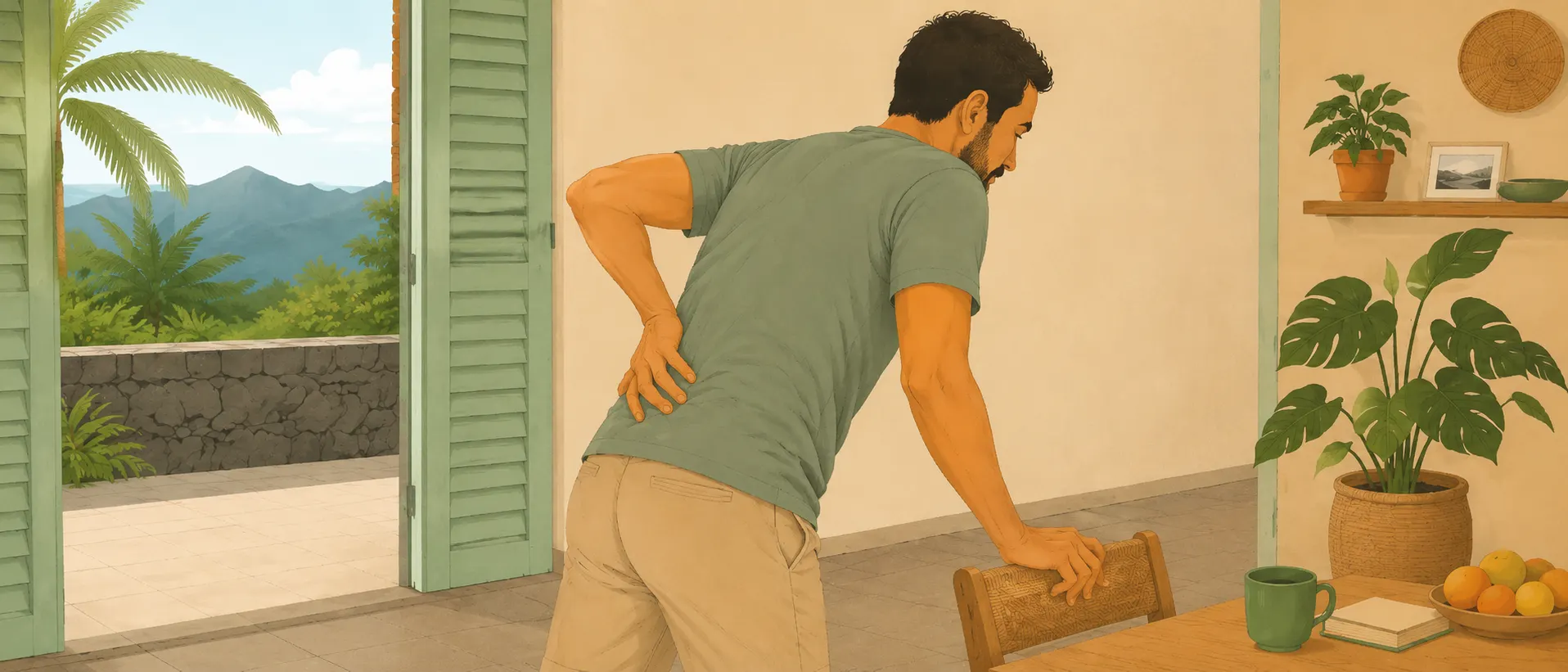
You bend down to pick something up. You twist slightly while lifting. You get out of the car. You move quickly in the garden, during sport, at work or while helping a child. And suddenly, your lower back seems to lock.
The pain can be sharp, intense and surprising. Moving feels difficult. Standing upright may feel impossible. Even sitting, turning in bed or taking a few steps can become uncomfortable.
This is often what people describe as lumbago, acute lower back pain, or simply “my back has gone”.
In many cases, the movement that triggered the pain was not the whole story. It may have been the final moment in a longer build-up of tension, load, fatigue or stress in the body.
What is lumbago?
Lumbago is a general term for pain in the lower back. It usually refers to pain or stiffness between the lower ribs and the buttocks. Some people feel it mainly on one side. Others feel it across the whole lower back.
The pain may stay local, or it may be felt into the buttocks, hips or upper legs. If pain, tingling, numbness or other symptoms travel further down the leg, especially below the knee, it is important to seek appropriate medical advice, as other structures may be involved.
Lumbago can be acute, meaning it comes on suddenly and strongly. It can also be recurring, where periods of lower back pain come and go over time.
Many episodes of lower back pain improve gradually, especially with appropriate movement, rest and care. But when the same pattern keeps returning, it may be worth asking a deeper question:
Why does the lower back keep going into protection?
When the lower back goes into protection
When your back suddenly locks up, it can feel as if something has gone badly wrong. But one important way to understand this reaction is protection.
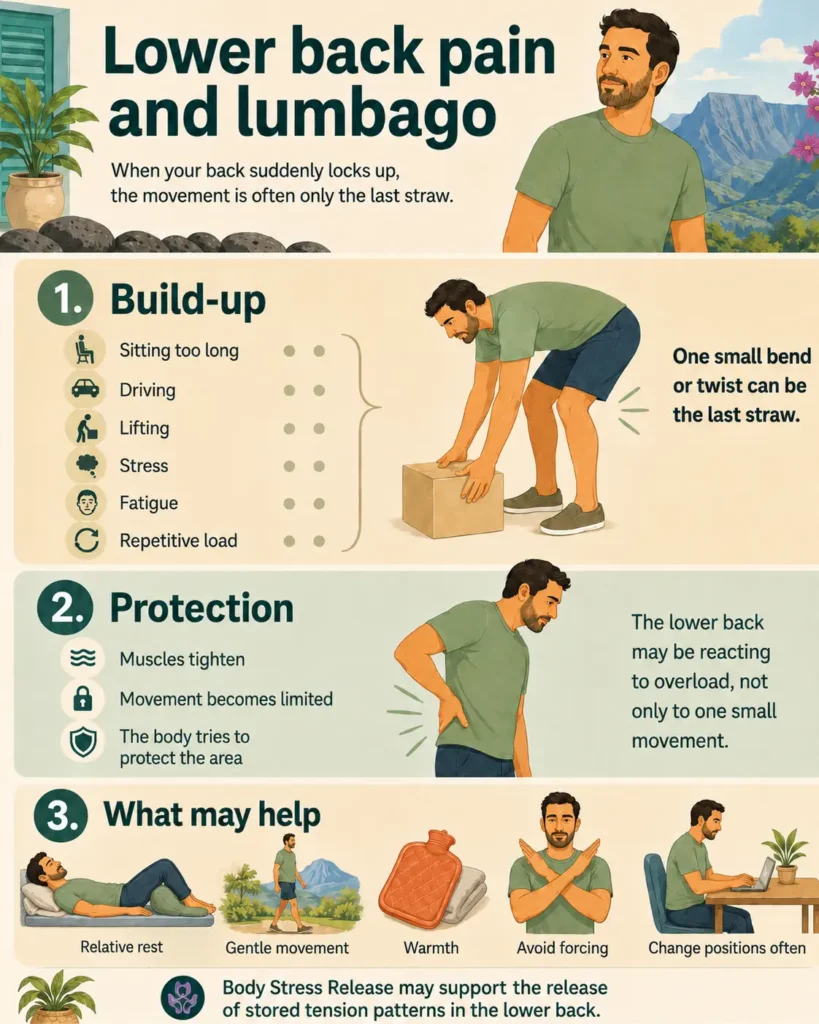
The body is designed to defend itself. If the nervous system senses that an area may be vulnerable, overloaded or at risk, the muscles around that area can tighten strongly. This limits movement. It can feel frustrating and painful, but the intention is protective.
The lower back may tighten to prevent you from bending, twisting or lifting further. In that moment, the body is essentially saying:
Stop. Do not move like that right now.
This does not mean the pain should be ignored. It also does not mean every case of lower back pain is simple. But it can help to understand that the body may be trying to protect, not punish.
The “last straw” effect
Many people say:
“I only bent down to pick up something small. Why did my back react so strongly?”
Often, the answer is that the small movement was not the real cause. It was the last straw.
Your lower back may already have been carrying more load than you realised. Perhaps you had been sitting for long hours. Driving more than usual. Training hard. Sleeping poorly. Lifting at work. Carrying children. Gardening. Travelling. Feeling under pressure. Or simply pushing through for too long without enough recovery.
Then one small bend, twist or lift becomes the moment the body can no longer compensate.
This is common with lower back pain. The trigger may seem minor, but the build-up behind it may have been happening for days, weeks or even longer.
If you recognise tension in several areas of your body, you may also find our article on 21 signs your body may be holding tension useful.
Why bending and twisting can be difficult for the lower back
The lower back is involved in almost everything you do: sitting, standing, walking, lifting, bending, turning and stabilising the body.
Certain movements can place more demand on it, especially when they are combined. Bending forward is one thing. Twisting is another. Lifting is another. When you bend, twist and lift at the same time, the lower back has to manage much more load.
This is why people often feel their back “go” during ordinary movements such as:
- picking something up from the floor
- lifting a bag from the car
- turning while holding weight
- working in the garden
- moving furniture
- bending over a child’s bed
- rushing through a task without paying attention
It is not always about one wrong movement. It is often about a movement happening at the wrong moment, when the body is already tired, tense or overloaded.
Acute lower back pain versus recurring lower back pain
An acute episode of lower back pain can be intense and alarming. The back may feel stuck, guarded or unable to move normally. In the first days, the body often needs a combination of rest, gentle movement and time.
Recurring lower back pain is different. This is when the same area keeps becoming painful, stiff or tense again and again. You may know the pattern well. After long driving, it returns. After sport, it returns. After standing all day, it returns. During stressful periods, it returns. After lifting, it returns.
Recurring lower back pain can be especially frustrating because it may improve for a while, then come back when life becomes physically or emotionally demanding again.
From a Body Stress Release perspective, recurring tension may indicate that the body has not fully let go of an old protective pattern.
What you can do when your lower back locks up
If your back has suddenly become painful, the first step is not to panic. A protective response can feel dramatic, but many people improve gradually with appropriate care.
Here are a few general principles that may help.
Give the body relative rest
Rest does not always mean staying in bed all day. In fact, too much immobility can sometimes make the body feel stiffer. But it is wise to reduce heavy lifting, intense sport, repeated bending and movements that clearly aggravate the pain.
The body may need time and energy to settle. Respecting that can support recovery.
Keep moving gently within your limits
Gentle movement is often better than complete stillness. Short walks, changing position regularly, standing up carefully, lying down when needed and moving within a comfortable range can help the body feel safer.
The key is not to force. If the lower back is in protection, aggressive stretching or pushing through pain can make the body guard even more.
Think of movement as a way of reassuring the body, not challenging it.
Use warmth if it feels helpful
Many people find warmth comforting when the lower back muscles are tight. A warm shower, bath, heat pack or warm cloth may help the area feel less guarded.
Heat is not a cure, but it can support relaxation and make gentle movement easier.
Be careful with sitting for long periods
Sitting can place pressure on the lower back, especially when you slump or stay in the same position too long.
If sitting is uncomfortable, alternate between sitting, standing, walking and lying down. Small changes of position throughout the day can be more helpful than trying to find one perfect posture and holding it for hours.
Ask for medical or pharmaceutical advice when needed
If the pain is intense, medication may sometimes help reduce pain enough to allow rest and gentle movement. Ask a doctor or pharmacist what is appropriate for your situation, especially if you have other health conditions, take other medication, are pregnant, or are unsure.
Also remember that pain relief can make it easier to overdo things. Even if the pain is reduced, the body may still need careful handling.
When to seek medical advice
Lower back pain is common, but some signs should be taken seriously.
Seek urgent medical advice if lower back pain follows a serious accident, or if it is accompanied by loss of bladder or bowel control, numbness around the groin or saddle area, weakness or numbness in both legs, fever, unexplained weight loss, or severe pain that does not ease.
You should also consult a healthcare professional if the pain is persistent, worsening, unusual, or if you are worried.
Body Stress Release does not replace medical diagnosis or treatment. If there may be a medical condition, injury or neurological involvement, it is important to have that assessed appropriately.
How Body Stress Release looks at lower back tension
Many people come to Body Stress Release because their lower back keeps holding tension.
Sometimes they have had one acute episode where the back suddenly locked up. Sometimes they have recurring lower back stiffness. Sometimes they notice tension after sitting, driving, lifting, sport or stress. Sometimes the back feels better for a while, but the same pattern keeps returning.
Body Stress Release works with the idea that the body can store tension when it has been exposed to more stress than it could process at the time. This stress may be physical, emotional, mental or chemical. In the lower back, it may be linked to accidents, falls, posture, lifting, repetitive movement, sport, long sitting, emotional pressure or accumulated life load.
During a session, the practitioner uses gentle muscle testing to observe where the body appears to be holding tension. Light, precise releases are then made to support the body in letting go of stored tension, layer by layer.
The aim is not to force the back into change. It is to give the body information and support so that it can respond in its own time.
Why the lower back often carries so much
The lower back is a central area of support.
It connects the upper body with the pelvis and legs. It helps you stand, walk, lift, bend, turn, sit and stabilise. It is involved when you carry a child, work at a desk, drive across the island, hike in the mountains, train hard, clean the house or spend long hours on your feet.
It also reacts when life feels heavy. Many people unconsciously brace the lower back, abdomen, pelvis or hips when they are under pressure. Over time, this can become a familiar holding pattern.
That is why lower back pain is not always only about the lower back. It may reflect how the whole body has been adapting.
Lower back tension can also appear when the body stays in a state of alert. Read more in Always tense, even at rest?

Caring for your lower back before it locks up again
If your lower back has locked up once, or if you know it tends to become tense, there are practical ways to support it.
Move regularly during the day. Avoid staying in one position for too long. When lifting, keep the object close to you and avoid twisting at the same time. Pay attention when you are tired or rushed, because that is often when small movements become less controlled.
If you sit a lot, change position often. If you train hard, allow proper recovery. If you drive long distances, take breaks when possible. If you are going through emotional stress, remember that your body may be carrying part of that load too.
The goal is not to become afraid of movement. The goal is to give the body more support, more awareness and more chances to recover.
When lower back pain keeps returning
If your lower back pain keeps returning, it may be useful to look beyond the most recent painful moment.
The question is not only:
What did I do yesterday?
It may also be:
What has my body been carrying for a long time?
Repeated lower back tension can be a sign that the body is still protecting, compensating or holding stress from earlier experiences. This may include physical overload, old falls, sport, work posture, emotional stress or long periods without real recovery.
Body Stress Release offers a gentle way to explore these tension patterns and support the body in releasing what it no longer needs to hold.
Recognise this pattern?
If you recognise the feeling of a lower back that suddenly locks up, or a back that keeps becoming tense, stiff or guarded, your body may be asking for attention.
At Body Stress Release Réunion, we offer gentle, practical sessions for people with lower back tension, recurring stiffness and bodies that seem to stay in protection. Sessions are available in English and French, for residents of Réunion as well as people staying on the island temporarily.
You can also learn more about how Body Stress Release works on our main Body Stress Release information page.