
When tension, heaviness or discomfort start to build
Stress is often spoken about as something mental or emotional.
But for many people, stress becomes impossible to ignore when it begins to show up physically in the body.
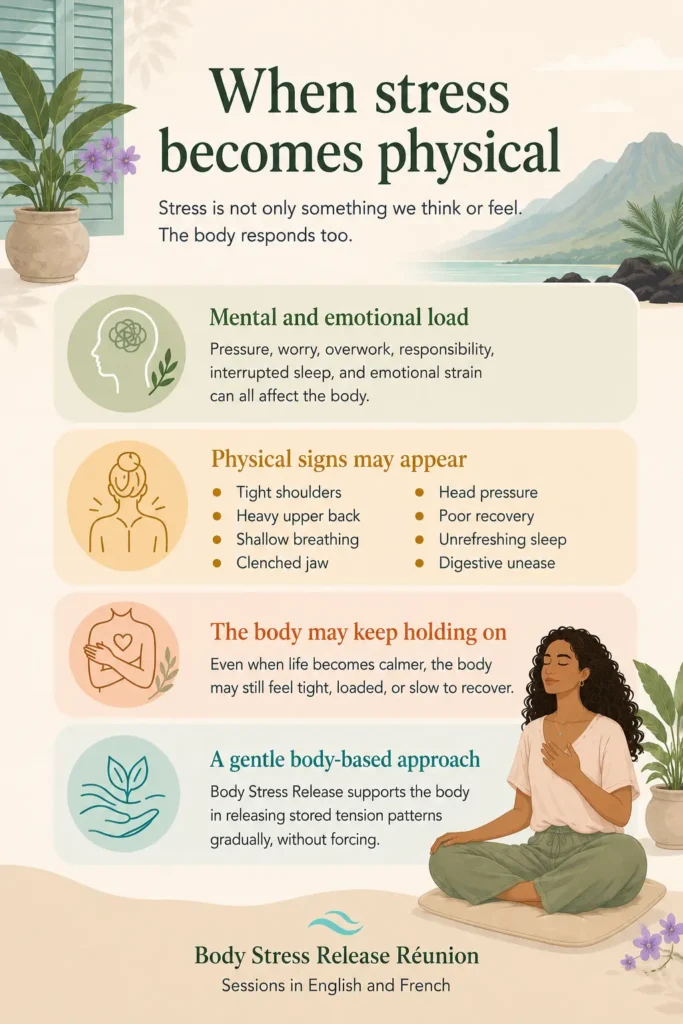
It may appear as tension in the shoulders, a heavy upper back, shallow breathing, a clenched jaw, recurring headaches, digestive unease, poor recovery, or the feeling that the body is carrying more than it can comfortably hold.
Sometimes these signs build gradually. Sometimes they become more noticeable after a particularly demanding period. And sometimes the body continues to hold on to them even after life has started to calm down again.
That is often the moment when people realise: this is no longer only stress in the mind. It has become physical in the body.
Stress is not always only mental or emotional
Stress is often described in psychological terms.
People talk about pressure, worry, overload, mental fatigue, emotional strain, or the sense of constantly having too much to manage. All of that is real. But stress is not only something we think or feel. It is also something the body responds to.
The body adapts to stress in order to keep going.
At first, that may seem manageable. You function. You carry on. You do what needs to be done. But over time, stress can begin to leave a more physical imprint. The body may start tightening, bracing, compensating, or holding on in ways that do not simply disappear on their own.
That is often when stress stops feeling abstract and starts feeling physical.
What many people begin to feel in the body
When stress becomes physical, it does not always show up in one single way.
For some people, it is mainly tension. For others, heaviness, discomfort, poor recovery, or the sense that the body feels loaded all the time.
People often describe things such as:
- tight shoulders or neck
- a body that feels heavy or physically burdened
- a jaw that keeps clenching
- breathing that feels shallow or slightly held
- recurring headaches or a sense of pressure
- poor sleep or sleep that does not feel refreshing
- digestive unease during or after stressful periods
- tiredness combined with physical tension
- the feeling that the body never fully relaxes
These experiences do not always come all at once. They may build gradually and become part of daily life before someone fully notices how much the body has been carrying.
Why the body may start carrying stress physically
The body is not separate from stress. It responds to what life asks of it.
Pressure, emotional strain, interrupted sleep, ongoing responsibility, overwork, repetitive strain, uncertainty, or simply having had to keep going for too long can all leave a mark on the body.
The body protects. It adapts. It keeps functioning.
But when that pattern continues for too long, some people begin to feel that the body no longer returns easily to ease. Tension remains. Heaviness remains. Recovery feels incomplete. The body may continue to carry what it has not yet released.
This does not necessarily mean that something dramatic is wrong. But it can mean that stress has become embodied.
When physical stress does not simply disappear
One of the confusing things about physical stress is that it does not always disappear when the stressful period ends.
You may try to rest more, sleep more, reduce your schedule, or take things more gently, and yet still feel that the body remains tight, loaded, or slow to recover.
For some people, this becomes the most frustrating part. Life may have become calmer, but the body has not fully followed.
That can create a strange mismatch:
- the mind wants to slow down
- but the body stays tight
- the urgent period is over
- but the body still feels burdened
- rest is present
- but real release does not seem to happen
That is often where people begin looking for a body-based approach.
How Body Stress Release may help when stress becomes physical
Body Stress Release is a gentle approach that helps the body release stored tension patterns.
It does not aim to diagnose medical conditions, and it does not replace medical care. But some people seek Body Stress Release when stress is no longer only emotional or mental, and is being felt clearly in the body.
The focus is not on forcing the body.
It is not about aggressively correcting symptoms.
And it is not about pushing through discomfort.
Instead, Body Stress Release works with the body’s own responses and supports a gradual release of accumulated tension.
For some people, this may contribute to a greater sense of ease, more comfort, deeper rest, or the feeling that the body can begin to let go more freely again. For others, the shifts are more gradual.
A gentle approach to accumulated tension
When stress has been affecting the body for some time, it is natural to hope for quick change.
But in many cases, release happens progressively.
That is why Body Stress Release is often approached as a process rather than a one-off session. At Body Stress Release Réunion, we begin with an initial phase of at least three sessions so that there is space to observe how the body responds over time.
Every body has its own history. And when stress has become physical in the body, the body may need time, consistency, and the right kind of support before deeper changes begin to unfold.
When this approach may be worth exploring
Body Stress Release may be worth exploring if:
- stress often seems to affect you physically
- your body feels tense, heavy, or loaded during stressful periods
- you find it difficult to relax properly
- the body seems to hold on even after life becomes calmer again
- rest does not always bring real release
- you feel that stress is no longer only mental, but also physical in your body
In Réunion, in French and English
We welcome clients in Réunion by appointment, in both English and French.
If this experience of stress becoming physical in the body sounds familiar, you are welcome to book a first session or ask us a question on WhatsApp.