
A practical guide to recognising stored tension before it starts to feel normal
If you have ever wondered whether your body is holding tension, the signs are not always dramatic.
A stiff neck. A tight lower back. Shoulders that stay lifted. Restless sleep. A body that feels tired, heavy, tense or difficult to relax.
At other times, the signs are less obvious. You may not feel “stressed” in the usual sense of the word. Life may even seem relatively normal. But your body still feels as if it is carrying something.
What does it mean when the body is holding tension?
When we talk about the body holding tension, we are not talking about one single symptom or one simple cause. Tension can build gradually through physical strain, emotional pressure, mental load, accidents, posture, sport, lack of recovery or simply doing too much for too long.
Body Stress Release works with the idea that the body can store tension when it has been exposed to more stress than it could process at the time. This does not replace medical diagnosis or treatment. It is a gentle approach focused on observing where the body may be holding stress and supporting a process of release.
Here are 21 signs that your body may be holding too much tension. The infographic below groups them into four themes: body and movement, load and posture, recurring tension patterns, and recovery and body awareness.
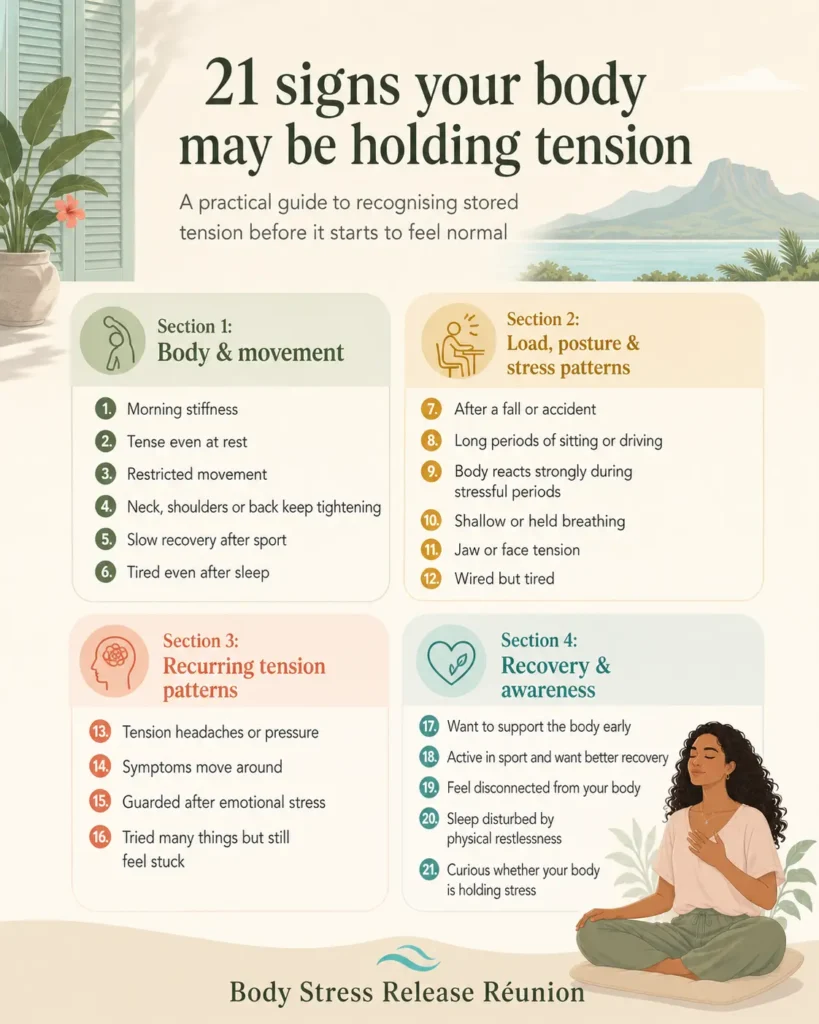
21 signs your body may be holding tension
1. You often feel stiff when you get up
Morning stiffness is one of the most common ways people notice tension in the body.
You may need time to “start up” before you can move comfortably. Your back may feel rigid. Your neck may not turn easily. Your hips, legs or shoulders may feel as though they need warming up before the day can really begin.
There can be many reasons for this: sleep position, mattress quality, hydration, age, physical activity or medical conditions. But when stiffness appears regularly, it can also be a sign that the body is not fully letting go during rest.
Instead of waking up restored, the body wakes up still holding tension from the day before.
2. Your body feels tense even when you are resting
Rest is not always the same as relaxation.
You may sit down at the end of the day, but your body does not soften. Your shoulders stay raised. Your jaw remains tight. Your breathing stays shallow. You may feel physically still, but internally your system remains switched on.
This can happen when the body has spent a long time in a state of readiness. It has learned to protect, brace or prepare for action. Even when there is no immediate danger, the body may continue to behave as if it still needs to stay alert.
A body that cannot fully settle is often a body that has been carrying tension for too long.
3. Movement feels restricted or uncomfortable
Stored tension can affect how freely you move.
You may notice it when bending, turning, reaching, walking, exercising or getting out of a chair. It may not be sharp pain. It may simply feel as though your body has less space, less fluidity, or less trust in certain movements.
When muscles remain tense, other areas may start to compensate. One part of the body works harder because another part is not moving freely. Over time, this can make movement feel less natural and more effortful.
Many people describe it as feeling older than they are, or as if their body has become cautious.
4. Your neck, shoulders or back keep tightening
The neck, shoulders and back are common places where people notice tension first.
These areas are involved in posture, movement, protection and daily effort. They respond when you sit for long periods, carry bags, lift children, work at a screen, train hard, drive often or go through emotional stress.
Tension in these areas may come and go. Or it may become so familiar that you no longer notice how tight the muscles are until someone touches them, or until the discomfort becomes difficult to ignore.
When the same areas keep tightening again and again, it may be worth looking beyond temporary relief and asking why the body keeps returning to that pattern.
5. You recover slowly after sport or physical work
An active body also needs recovery.
Whether you run trails, do CrossFit, cycle, hike, swim, surf, work physically or train several times a week, the body has to absorb load. Healthy movement is important, but repeated physical demand can still become too much when recovery is incomplete.
You may notice that soreness lasts longer than expected. Your muscles feel heavy. Your performance drops. Small restrictions appear. You feel that your body is working harder than it should.
This does not mean you need to stop moving. It may mean your body needs support in releasing tension patterns that have built up through repeated effort, impact or compensation.
6. You feel tired even after sleep or rest
Fatigue is not always only about the number of hours you sleep.
If the body is holding tension, it may continue working in the background even while you rest. Muscles do not fully soften. The nervous system remains active. Breathing may stay shallow. Sleep may happen, but it does not always feel deeply restorative.
You may wake up feeling as if the night was not enough. Or you may need frequent pauses, even when you have not done anything unusually demanding.
There are many possible reasons for ongoing fatigue, and medical causes should be considered when tiredness is persistent or unexplained. But for some people, part of the picture is that the body is using too much energy simply maintaining tension.
7. You have been through a fall, accident or physical shock
The body is designed to protect itself.
During a fall, car accident, sports injury or sudden impact, muscles can contract quickly to guard vulnerable areas. This protective response is useful in the moment. It helps prevent further harm and stabilises the body.
But sometimes, after the event has passed, the body does not fully release the protective pattern. A person may recover from the visible injury, but still feel different in their body afterwards.
The event may have happened recently, or many years ago. The body may still remember the shock through tension, restriction or guarded movement.
Body Stress Release practitioners often see people who say, “I have never felt quite the same since that accident.”
8. You sit, drive or work in one position for long periods
Modern life often asks the body to stay still for too long.
Desk work, driving, studying, screen time, administration, long flights and repeated sitting can all place steady strain on the body. Even with a good chair and decent posture, the body is not made to stay in one position for hours without variation.
Over time, certain muscles become overused, others underused, and the body adapts around the position it spends most time in.
You may feel this as a tight lower back, stiff hips, rounded shoulders, neck tension or general heaviness. The issue is not always one “bad posture”, but the lack of movement options throughout the day.
9. Your body reacts strongly to busy or stressful periods
Some people notice a clear link between life pressure and body tension.
During demanding periods, the body may become tighter, more sensitive or less comfortable. You may feel it in the neck, shoulders, stomach, jaw, chest, back or breathing. When life becomes intense, the body responds.
This does not mean the tension is “all in your head”. Emotional and mental stress are real forms of load. The body participates in them. It prepares, protects, holds and adapts.
When busy periods continue for too long, the body may not return easily to a relaxed baseline. Tension becomes part of how you get through the day.
10. Your breathing feels shallow or held
Breathing and tension are closely connected.
When the body is relaxed, breathing often feels easier, fuller and more natural. When the body is tense, breathing may become shallow, high in the chest, restricted or irregular.
Some people notice that they hold their breath while concentrating. Others sigh frequently, feel unable to take a satisfying breath, or breathe as though they are always slightly braced.
Of course, breathing difficulties should be taken seriously and medically assessed when needed. But in many everyday cases, people notice that their breathing changes when their body is tense or under pressure.
A body that holds tension often does not breathe as freely as it could.
11. You clench your jaw or hold tension in your face
The jaw is a powerful place to hold stress.
You may clench your teeth during the day, grind at night, press the tongue against the palate, tighten the face, frown without noticing, or wake up with jaw discomfort.
Jaw tension can be linked to concentration, emotional restraint, pressure, anger, worry or simply a body that has learned to brace. It may also appear alongside neck and shoulder tension, because these areas often influence one another.
Many people are surprised to realise how much effort they hold in the face. The body may be saying “I’m fine”, while the jaw is quietly telling another story.
12. You often feel “wired but tired”
This is a common modern pattern.
You feel exhausted, but not calm. You want to rest, but cannot fully switch off. You may be tired during the day and alert at night. Your body feels drained, but your system keeps running.
This can happen when the body has been operating in a high-demand state for too long. The energy is low, but the internal alertness remains high.
People often describe this as feeling stuck between two states: too tired to function well, but too activated to rest properly.
When the body is holding tension, relaxation may not happen simply because you have stopped moving. The system may need time and support to come down.
13. You have recurring tension headaches or pressure sensations
Many people experience headaches or pressure sensations when tension builds in the neck, shoulders, jaw or upper back.
This does not mean all headaches come from muscle tension. Headaches can have many causes, and recurring, severe or unusual headaches should be discussed with a healthcare professional.
But for some people, there is a noticeable pattern. The head feels heavy after a long day at the computer. Pressure builds when the neck is tight. The jaw, shoulders and upper back feel involved. Rest, stretching or massage may help temporarily, but the pattern returns.
In those cases, it can be useful to look at how much tension the body is carrying as a whole.
14. Your symptoms seem to move around
Some people find it difficult to explain what they feel because the discomfort is not always in the same place.
One week it is the lower back. Then the shoulder. Then the hip. Then the neck. The sensations may move, change or appear without an obvious reason.
This can be frustrating, especially when nothing seems consistent. It may feel as though the body is unreliable or unpredictable.
From a Body Stress Release perspective, the body is viewed as a connected system. Tension in one area can influence how other areas move, compensate or respond. The place where you feel discomfort is not always the only place where the body is holding stress.
15. You feel physically guarded after emotional stress
Emotional stress does not stay only in thoughts.
Grief, fear, pressure, conflict, worry, shock or prolonged responsibility can all have a physical effect. The body may tighten, close, protect or become more guarded.
You may notice this after a difficult period, a loss, a separation, family stress, work pressure or a time when you simply had to keep going. Even once the situation changes, your body may not immediately relax.
This is not weakness. It is a protective response.
The body often does its best to help you cope. But once the danger or pressure has passed, it may need support to release what it has been holding.
16. You have tried several approaches but still feel stuck
Many people come to Body Stress Release after trying several things.
They may have stretched, rested, exercised, changed their chair, had massages, taken time off, adjusted their routine or worked on stress management. Some things may have helped for a while, but the same tension keeps returning.
This does not mean those approaches were wrong. It may simply mean the body is holding tension at a deeper or more established level.
Body Stress Release does not replace medical care, physiotherapy, psychological support or other appropriate treatment. It offers a different perspective: instead of forcing the body to change, it works gently with the body’s responses and tension patterns.
17. You want to support your body before tension builds further
You do not need to wait until your body is in crisis before you pay attention.
Some people use Body Stress Release as a form of body maintenance. They may not have severe discomfort, but they can feel when their body is starting to accumulate tension. They prefer to respond early, before the pattern becomes more limiting.
This can be especially relevant if you have a physically demanding job, an intense sport routine, a stressful profession, a busy family life or a tendency to keep pushing through.
The body often whispers before it shouts. Listening early can be a wise choice.
18. You are active in sport and want to support recovery
Sport is healthy, but it is still a form of stress on the body.
Trail running, CrossFit, cycling, weight training, surfing, hiking, football, tennis, padel and other activities all require the body to adapt. Repetition, impact, intensity and competition can create tension patterns over time.
Athletes and active people often become very good at pushing through discomfort. But performance also depends on recovery, mobility, coordination and the body’s ability to adapt.
Body Stress Release may be useful for active people who want to support their body’s recovery and maintain a freer, more responsive sense of movement.
19. You feel disconnected from your body
Sometimes tension becomes so normal that you stop noticing it.
You may live mostly in your head, focused on work, responsibilities, planning, caring for others or getting through the day. The body becomes something that carries you around, rather than something you really listen to.
Then, at some point, the signals become louder. Pain, fatigue, stiffness, restlessness or discomfort force your attention back to the body.
Body Stress Release can help people become more aware of how their body is holding tension. For many, this awareness is already an important first step: noticing what has been ignored, adapted to, or accepted as normal.
20. Your sleep is affected by physical restlessness
Sleep can be disturbed not only by thoughts, but also by the body.
You may turn often, struggle to find a comfortable position, wake up with tension, feel restless in the legs or back, or notice that your body does not fully sink into rest.
Sometimes people say, “I am tired, but my body will not let me sleep.”
There are many possible reasons for sleep difficulties, and ongoing sleep problems deserve proper attention. But when physical tension is part of the picture, supporting the body may also support a better sense of ease at night.
A body that feels safer and less braced often has more possibility to rest.
21. You are curious whether your body is holding stress you no longer need
Sometimes the best reason is simple curiosity.
You may not have one dramatic complaint. You may not know exactly what is wrong. You may simply feel that your body could be more comfortable, more relaxed, more flexible or more at ease.
Body Stress Release does not require you to have everything figured out before you come. You do not need to know the exact cause of your tension. You do not need to decide whether it is physical, emotional, mental or lifestyle-related.
The session is an opportunity to observe where your body may be holding tension and to support a process of release, layer by layer.
You do not have to feel “stressed” to have body stress
One of the most important things to understand is this: body stress is not always the same as emotional stress.
You may feel mentally calm and still have physical tension. You may enjoy your life and still have a body that is overloaded. You may have adapted to discomfort for so long that it feels normal.
The body responds to many forms of stress: accidents, falls, repetitive posture, sport, illness, surgery, emotional strain, busy periods, lack of recovery, sensory overload and everyday pressure.
Over time, these stresses can add up.
Body Stress Release is based on the idea that when the body is supported in releasing stored tension, it may have more freedom to recover, move and adapt in its own way.
Recognise signs that your body is holding tension?
If you recognise several points in this list, your body may be asking for attention.
That does not mean something is wrong with you. It may simply mean your body has been carrying too much for too long.
At Body Stress Release Réunion, we offer gentle, practical sessions for people who want to understand where their body may be holding tension and support it in letting go. Sessions are available in English and French, for residents of Réunion as well as people staying on the island temporarily.
You can also learn more about how Body Stress Release works on our main Body Stress Release information page.