
When the body does not seem to recharge
Most people know what it feels like to be tired.
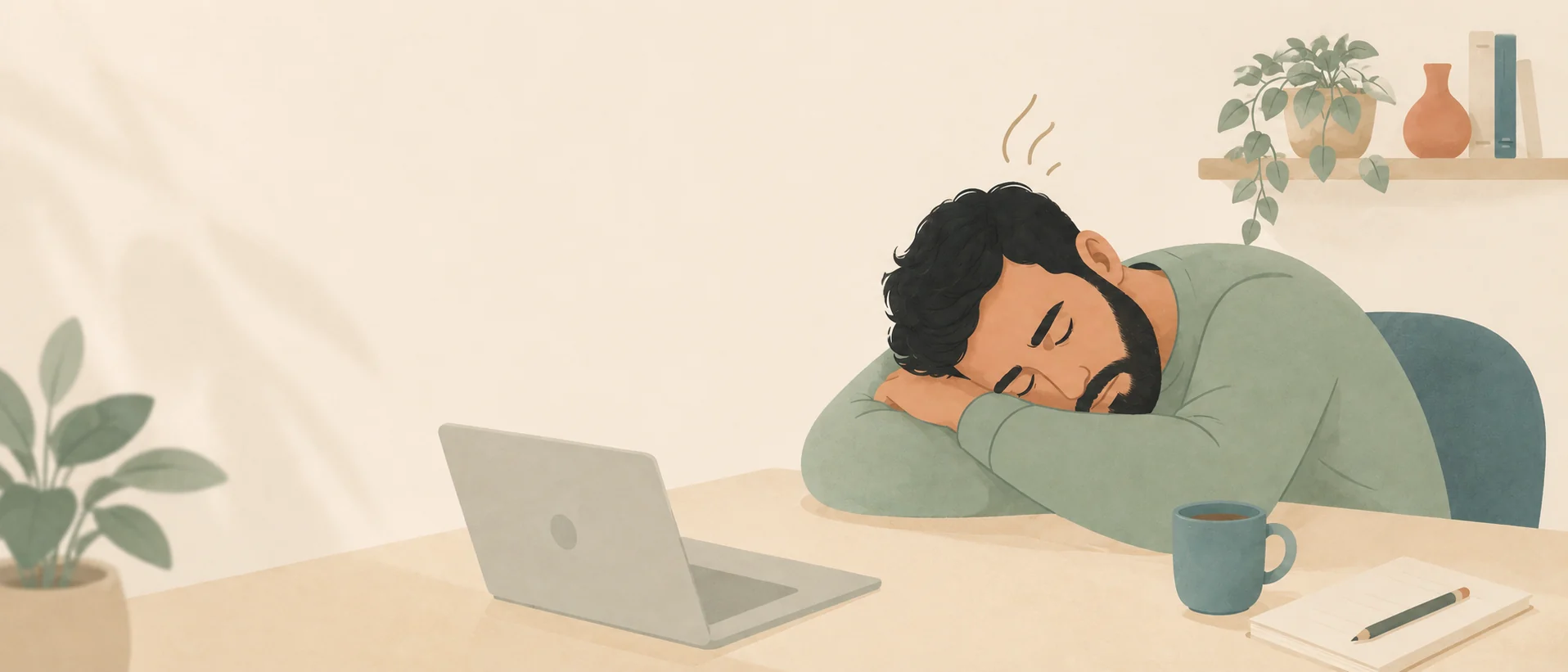
But there is another kind of tiredness: being still tired, even after rest.
You may sleep more, take a quieter day, go to bed earlier, or reduce your activities for a while. And yet the body still does not feel properly restored. There can be a sense of heaviness, low energy, or the feeling that your system has not really recharged.
It is not always easy to explain. You are resting, but your energy does not come back in the way you expected. You slow down, but the body still feels behind. It can feel as though you are never quite catching up.
For some people, this starts after a particularly busy or stressful period. For others, it builds more gradually over time. Life continues, but recovery starts to feel less natural than it used to.
When tiredness and poor recovery become familiar
Poor recovery does not always look dramatic from the outside.
Often, life continues. Work continues. Family life, responsibilities, routines, and obligations all continue. But underneath it, there is the feeling that the body is not really catching up.
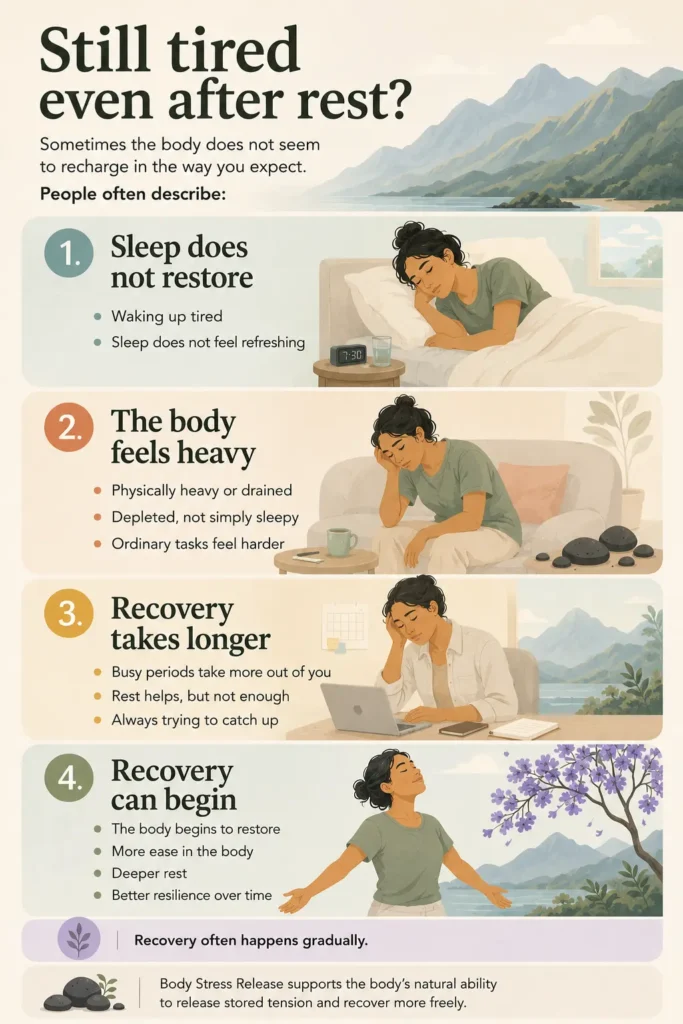
People often describe things such as:
- waking up tired even after sleep
- sleep that does not feel refreshing
- feeling physically heavy or drained
- needing more time to recover after busy periods
- feeling depleted rather than simply sleepy
- ordinary tasks feeling more demanding than usual
- rest helping a little, but not enough
- the sense that the body is always trying to catch up
Sometimes this happens after emotional stress, intense work, poor sleep, overtraining, physical strain, or simply having had to keep going for too long without enough real recovery.
For some people, tiredness is not only about needing more sleep. It can feel more like a deeper lack of recovery, where the body has not yet rebuilt its energy after a demanding period.
Why rest is not always the same as recovery
It is natural to think that more rest should solve the problem.
And sometimes it does. But not always.
Recovery is not only about stopping activity. It is also about whether the body is able to restore its energy, settle its internal load, and return to a more balanced state.
After long periods of pressure, stress, overload, or physical demand, the body may need more than a quiet day before it feels restored again. The busy period may be over, but the body can still feel as though it is working from a depleted place.
That can leave people in a frustrating in-between state: resting, but not recharged. Sleeping, but not refreshed. Doing less, but still feeling low in energy.
When the body has not fully recovered from stress
Body Stress Release is based on the idea that the body can store tension linked to stress.
This does not always appear as obvious or severe pain. It can also show up as a body that feels heavy, overloaded, slow to recover, or unable to regain its usual energy.
Some people who come to Body Stress Release do not mainly talk about pain. They talk about feeling drained, physically heavy, slow to recover, or as though their body has not bounced back after a demanding period.
Others already have a diagnosis or have tried other forms of support, but still feel that their body has not regained a deeper sense of ease and resilience.
That is often where a gentle approach may feel worth exploring.
How Body Stress Release may support better recovery
Body Stress Release is a gentle approach that helps the body release stored tension patterns.
It does not aim to diagnose medical conditions, and it does not replace medical care. But some people seek Body Stress Release when they feel that stress has become physical, rest is no longer enough, or the body seems slow to recover.
The focus is not on forcing the body.
It is not about pushing for change or overriding the body’s signals.
Instead, Body Stress Release works with the body’s own responses and supports a gradual release of accumulated tension.
For some people, this may contribute to a greater sense of ease, more comfort, deeper rest, or the feeling that the body can begin to recover more freely again. For others, the changes unfold more gradually.
Recovery often happens in stages
When you have been feeling tired for a while, it is natural to hope for quick relief.
But in many cases, recovery takes place gradually.
That is why Body Stress Release is often approached as a process rather than a one-off session. At Body Stress Release Réunion, we begin with an initial phase of at least three sessions so that there is space to observe how the body responds over time.
Every body has its own history. And when recovery has felt limited for a while, the body may need time, consistency, and the right kind of support before deeper changes begin to appear.
When this approach may be worth exploring
Body Stress Release may be worth exploring if:
- you are still tired, even after rest
- sleep does not leave you feeling refreshed
- you feel that your body does not recover properly
- you feel depleted after stress or busy periods
- your body feels heavy, slow, or drained
- ordinary tasks feel more demanding than usual
- rest helps, but not as much as you would expect
In Réunion, in French and English
We welcome clients in Réunion by appointment, in both English and French.
If this sounds familiar, you are welcome to ask us a question on WhatsApp or book a first session. You can also read more about how Body Stress Release works.